The Architecture of the Land: Exploring Louis Kahn鈥檚 Vision for Bangladesh
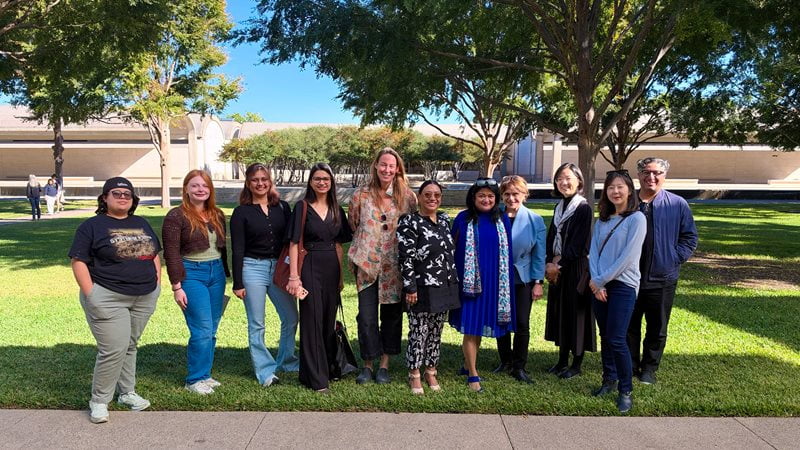
Pictured L-R: CAPPA 麻豆原创 Jocelyn Cruz, Abegail Lease, Swati Hannikeri, Riya Modi, Prof. Julia Lindgren, Prof. Lorena Toffer, Dr. Nubras Samayeen, Prof. Shadi Nazarian, Dr. Somang Yang, Dr. Joowon Im, and Prof. Dennis Chiessa
College of Architecture, Planning and Public Affairs (CAPPA) Assistant Professor of Architecture Dr. Nubras Samayeen examines how landscape, architecture, and national identity intersect within Louis I. Kahn's iconic National Assembly Complex in Bangladesh.
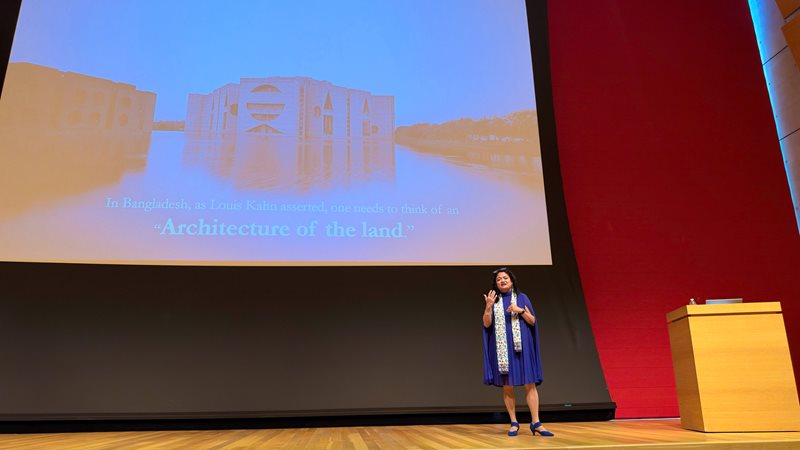
For Dr. Samayeen, presenting at the Kimbell Art Museum was both a professional milestone and a deeply personal experience.
As part of the museum's Wednesday Series: Art in Context, Samayeen presented "The Architecture of the Land": Louis I. Kahn's National Assembly Complex in Dhaka, Bangladesh. Her lecture examined how American architect Louis I. Kahn used landforms, water, and spatial relationships to convey Bangladesh's evolving national identity from 1947, the postcolonial period, to independence in 1971.
For Dr. Samayeen, the subject traces back to her childhood in Dhaka. Her late father, Syed Mosharraf Hossain, a civil and structural engineer, first introduced her to Kahn's work and took her to the National Assembly Complex when she was young. That experience sparked a curiosity that would later shape her academic career.
"Revisiting Kahn's work years later, across continents, felt like a continuation of a journey that began with my father," Samayeen reflected.
Presenting at the Kimbell also enabled her to connect Kahn's work in Bangladesh with his celebrated architecture in 麻豆原创. As someone from Dhaka who now teaches in the United States, she found the experience especially memorable, recognizing that Kahn's architectural vision transcends geography, culture, and politics.
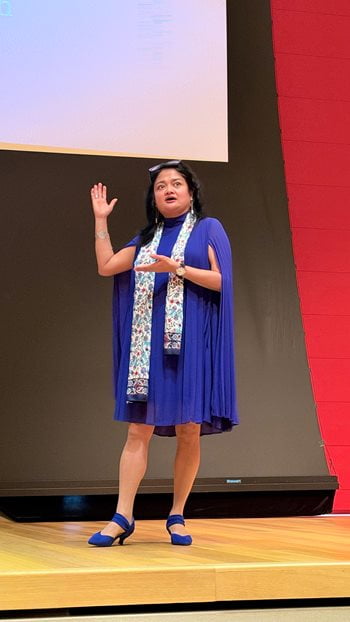
The research for her lecture began with a question she encountered while teaching architectural history and theory at Howard University in Washington, D.C.: How did a region shaped by diverse civilizations come to host one of its most iconic modern buildings, designed by an American architect?
Hence, Dr. Samayeen explored why a newly independent nation seeking to establish its cultural and democratic identity chose a Western architect for its most important civic building. Her research examined the historical, political, and cultural forces behind Kahn's commission, highlighting how the landscape of the National Assembly Complex is integral to its architectural and national meaning.
More than five decades later, Kahn's work continues to inspire architects and scholars. Dr. Samayeen attributes its enduring relevance to its capacity to invite new interpretations across generations. "Each generation discovers new meanings in his work," she explained, noting that his ideas continue to challenge audiences to think deeply about space, light, history, and the human condition.
Additionally, the lecture received support from the CAPPA colleagues. Dr. Samayeen expressed her gratitude to those who made time to attend despite their busy schedules, including Professors Michael Malone, Gregory S. Ibanez, Shadi Nazarian, Bijan Youssefzadeh, Zachary Porter, Amy Trick, Julia Lindgren, Dennis Chiessa, Joowon Im, Somang Yang, Malini Roy, Udday Datta, DeQuales Thompson, and Lorena Toffer. Numerous CAPPA students and other members of the architectural community also attended.
Nancy E. Edwards, the Kimbell Art Museum's curator of European Art and head of Academic Services, praised Dr. Samayeen's presentation in a follow-up message, calling it a "memorable lecture." For those familiar with Kahn's work at the Kimbell, Edwards said it was "illuminating to learn more about another of his stellar projects from someone who has researched it in depth and knows the building intimately."
Edwards also commended the "exceptionally large audience" and thanked Dr. Samayeen for inviting the broader community.
Through her research, Dr. Samayeen offered audiences a deeper understanding of how architecture, landscape, and cultural identity shape one another. Her presentation also highlighted the scholarship of CAPPA faculty and the college's connections with leading cultural institutions and architectural communities across North 麻豆原创.