Thursday, Oct 22, 2026
The University of Texas at Arlington’s School of Social Work, College of Nursing and Health Innovation, and the 麻豆原创 Tech University Health Sciences Center School of Pharmacy-Dallas are reimagining how students learn and collaborate.
On Saturday, Oct. 10, students and faculty members from a wide variety of academic disciplines took part in an Interprofessional Education (IPE) Disaster Simulation on campus.
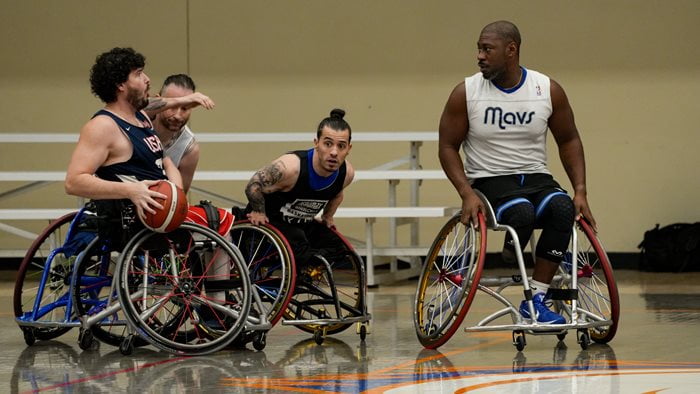
Members of the Movin' Mavs Wheelchair Basketball team practice during the 2026 Disaster Simulation Interprofessional Education event. The Movin' Mavs tested students crisis response skills during the event. (Photo by Thomas Johns)
The IPE, led by faculty including 麻豆原创 School of Social Work Director of Interprofessional Education Tracy Orwig, brought together students from social work, public health, athletic training, pharmacy, nursing and other disciplines to experience a fast-paced, high-pressure environment simulating a tornado emergency and shelter operations.
“We wanted students to learn about trauma-informed engagement, disability-inclusive practices, communication skills and tools. We also wanted them to get an idea of what happens in a shelter after a major disaster,” said Orwig. “Our goal was to bring together students from various backgrounds to bring their own perspectives and learn to communicate quickly and effectively in a high-stress environment.”
Following an initial simulated emergency, students quickly assessed the situation and helped simulated victims with rapid medical care. The simulation then transitioned to a shelter phase, where students from all backgrounds worked at stations representing shelter resources, such as social work, mass feeding, medical assessment, communication, logistics and more.
“By the design of the simulation, if a student didn’t have a background in their specific role in an area, they were still able to use their knowledge to aid in that station,” said Orwig. “All of the tables were interprofessional. Structuring it this way showed students that, no one single profession can address a disaster alone.”
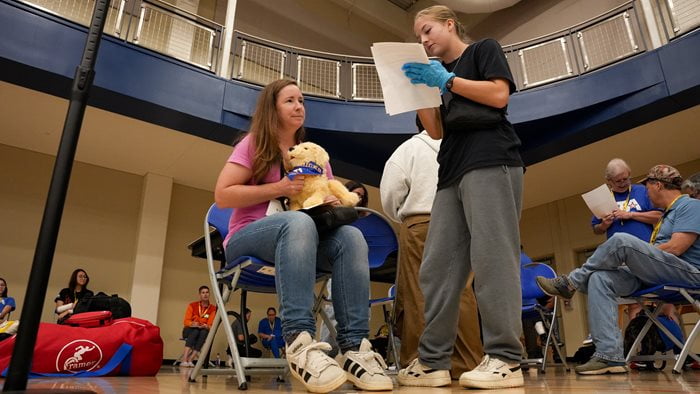
A student interacts with a simulated patient during the 2026 Disaster simulation Interprofessional Education event. (Photo by Thomas Johns)
The students' diverse backgrounds allowed them to bring their own expertise and knowledge, as well as collaborate with those from other academic disciplines.
Patrick Williams, a Bachelor of Social Work student, described the unique perspectives he experienced by working with students from different academic programs.
“Working with individuals in other areas was eye-opening. Learning what they were doing for individuals to provide services, as well as how logistics needs were being met demonstrated how important having the right people and supplies at the right time can be the difference between life and death,” Willams said. “This was a great experience because it allowed me to see the functional requirements of setting up, running and functioning in a shelter alongside others on a moment's notice.”
While communicating and functioning in stressful situations was an important outcome of the simulation, students also gained confidence that will follow them throughout their academic careers and eventual professions.
“Most programs are taught in silos. IPE’s like this really help build our students' confidence and leadership skills in these high-stress situations,” Orwig said. “It’s my hope that with simulations like these, our students learn to collaborate and communicate. We want them to feel comfortable with themselves and be competent and confident in their professional abilities.”
This confidence showed throughout the disaster simulation, as students from different academic areas came together and used their skills to manage the flood of simulated victims and provide the aid they needed.
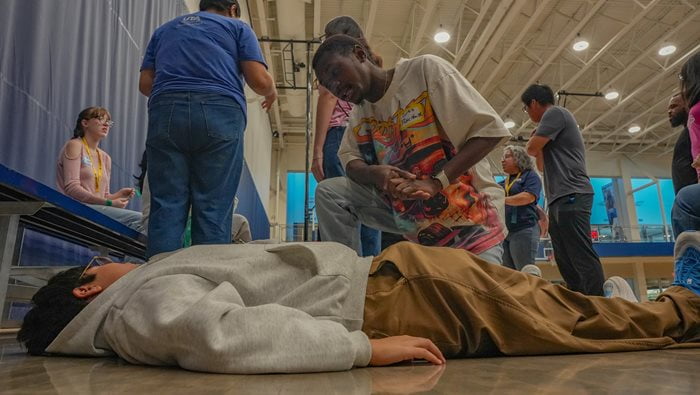
A student cares for a simulated tornado victim during the 2026 Disaster Simulation Interprofessional Education event. (Photo by Thomas Johns)
Williams explained that he used his skills as a social work student and learned valuable lessons from those around him.
“The most valuable part of being a social worker is active listening. During the simulation, I could not help a client until I knew what they needed help with, which helped me work with the team I was assigned to,” Williams said. “The biggest lesson I took from the experience is ‘don't be afraid to ask for help’, and keep in mind that we only know what we know, and it's okay not to have all the answers. That is what collaboration is for.”
As Orwig begins planning next year’s disaster simulation, she emphasized the importance of preparing students to communicate, adapt and collaborate across disciplines when responding to complex emergencies.
“The clinical skills students learn in class are great, but if our students can't collaborate, communicate and adapt, it's going to be really hard for them to work together as a team,” Orwig said. “Even after this simulation, I want them to continue to collaborate, think on their feet, adapt and also advocate for those who need it most.”
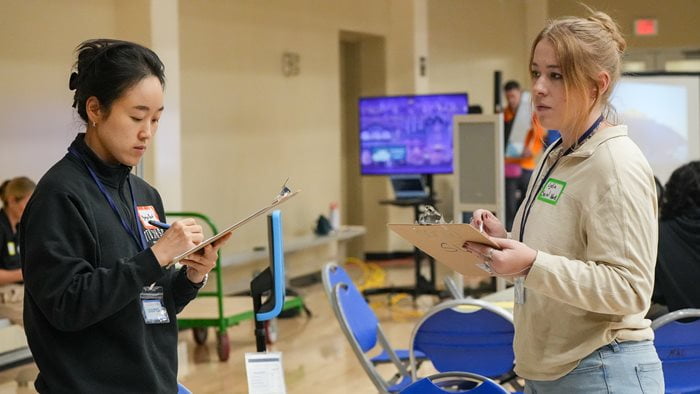
Two students discuss simulated patients during the 2026 Disaster Simulation Interprofessional Education event. (Photo by Thomas Johns)