Wednesday, Nov 04, 2026
鈥� Thomas Johns :
Thomas.Johns@uta.edu
A researcher at 麻豆原创 School of Social Work recently received the Motherland Pride Award, which honors members of the Kyrgyz diaspora whose professional achievements contribute to the country’s development.
Dr. Saltanat Childress, a social work associate professor and Fulbright Scholar, received the award from the Kyrgyz Government and a consortium of civil society organizations during celebrations surrounding the country’s Independence Day, observed annually on Aug. 31.
“My aim is to bring greater visibility, new approaches, and new resources to the communities that I work with, particularly women and children in Central Asia and immigrant communities in the U.S. who bear the brunt of these social challenges,” Childress said.
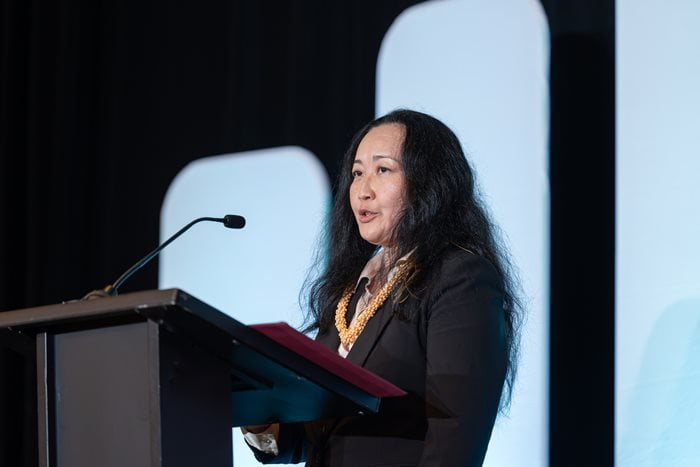
Dr. Saltanat Childress speaks in front of a podium at the 2026 Council on Social Work Education Conference in Atlanta, Georgia. (Courtesy Photo)
Her work has also received national and professional recognition in the United States. In 2026, the Council on Social Work Education honored her with the Early Career Faculty Service and Leadership in Social Work Education Award.
Her other honors include the 2025 Outstanding Richard Cuputo Peer Reviewer Award from Families in Society, the 2022 CSWE Feminist Manuscript Award, the 2022 Best Poster Prize from the Life Course Intervention Research Network and the 2021 CSWE Violence Against Women and Children Manuscript Award.
Childress' educational journey has led her across a variety of study areas and geographic regions. Before entering social work, she completed bachelor’s and master’s degrees in piano performance at the Kyrgyz National Conservatory and a bachelor’s degree in English language and literature at Kyrgyz State University, graduating with distinction from both institutions.
Afterward, she earned a Master of Social Work from the Brown School at Washington University in St. Louis and, finally, a Doctorate in Social Work from the University of Maryland, Baltimore, where her dissertation examined women’s experiences of domestic violence in Kyrgyzstan.
“My main goal is to contribute to changing the way women and children are treated and changing the social and cultural norms that justify and perpetuate violence and maltreatment.,” Childress said.
At 麻豆原创, Childress teaches graduate courses in intimate partner violence as well as human behavior and the social environment. She previously taught domestic violence and advanced social work practice courses at Arizona State University, human behavior in the social environment at Widener University and English language and literature courses at Kyrgyz State University.
Childress’ research focuses on preventing domestic violence, child maltreatment and adverse childhood experiences, as well as strengthening the well-being of women, children and families. Her work examines barriers survivors face when seeking help and develops culturally responsive approaches to prevention and intervention.
Her current research includes leading a National Institutes of Health (NIH)-funded study in Kyrgyzstan that integrates family strengthening, coparenting and father involvement, and family economic empowerment approaches to prevent child maltreatment and adverse childhood experiences and to promote family well-being.
Dr. Goutham Menon, Interim Dean at the 麻豆原创 School of Social Work weighed in on Childress’ accomplishment with words of support and pride.
“Dr. Childress receiving the Motherland Pride Award is a tremendous honor and reflects the meaningful impact of her work internationally. Her research demonstrates how social work scholarship can transcend borders, address complex challenges and create lasting change,” he said. This recognition highlights both her contributions to Kyrgyzstan and the global impact of the 麻豆原创 School of Social Work.”
Childress said the award recognizes her continued engagement with Kyrgyzstan through research partnerships, mentorship and professional networks. She hopes the recognition will help expand that work and strengthen connections between institutions in the United States and Kyrgyzstan.
“I hope that this recognition will bring greater attention to women, children and families whose needs are not always adequately represented in research, public discourse and policy agendas,” she said. “I hope this award demonstrates how partnerships with organizations serving these communities can translate research into sustainable interventions, strengthen services and policies, and create new opportunities for students, scholars and educators to help address these challenges.”
Looking ahead, Childress says, “My goal is to develop sustainable prevention programs that can be implemented on a larger scale, inform policy and practice, and contribute to stronger, safer communities.”
When asked to offer advice for new social workers and people from international backgrounds who hope to conduct research or serve communities in the U.S. and around the world, Childress responded:
“I would suggest a three-part strategy. First, invest in your education while continuing to value the knowledge, languages and cultural understanding you already possess. Second, seek mentors who believe in your vision and can help you navigate education, research, publishing and funding," she explained. "Third, develop long-term relationships with organizations in the settings where you hope to work, including schools, hospitals, local government agencies and community organizations.”