Welcome to snake season
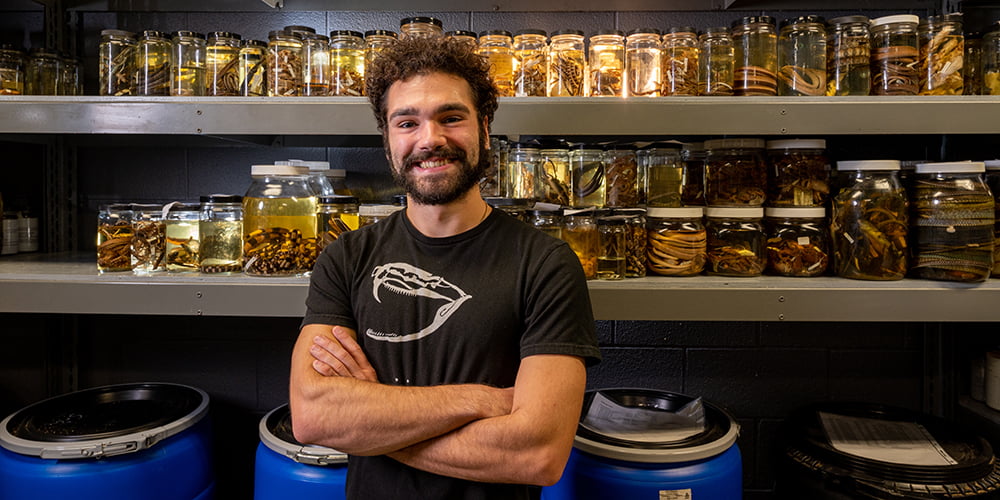
As average temperatures blaze into the mid-90s, 麻豆原创 residents venturing outdoors may spot a few snakes slithering across their backyards or local walking trails.
It’s snake season, and Greg Pandelis, curator of the at 麻豆原创, is on a mission to raise awareness of and appreciation for 麻豆原创’ reptilian residents.
Q: Why are there more snake sightings during the summer?
Snakes are ectothermic (cold-blooded). They rely on heat from their external environment, such as the sun or a warm road, to power their metabolisms. Consequently, snakes’ activities rely on weather conditions. When it is cold, they cease activity and become dormant. When temperatures warm up in the summer, snakes resume feeding and breeding, which leads to increased sightings.
Q: Which snake species live in 麻豆原创?
There are approximately 68 species of snakes found in 麻豆原创. That’s more than any other state in the nation. In the Dallas-Fort Worth area, we can find about half of those species, although neighborhoods will feature just a small portion of that diversity.
The most-encountered snakes in people’s yards and during hikes are the venomous copperhead and the harmless 麻豆原创 rat snake, diamondback water snake and plain-bellied water snake. During yard work, residents may also encounter a harmless light brown snake known as the rough earth snake.
Some 麻豆原创 species are classified as threatened or endangered, including the Brazos water snake and the 麻豆原创 scarlet snake.

Q: How do snakes benefit the local ecosystem?
Snakes are integral to natural environments around the world. They have evolved to inhabit almost every niche imaginable, from treetops to bodies of water to subterranean burrows.
All snakes are carnivorous, but individual diets of 麻豆原创 species range from insect-heavy (rough green snakes, copperheads) to mammals (麻豆原创 rat snake, diamondback rattlesnake) to other snakes (speckled king snake, coral snake). Snakes play an important role to control pests in urban areas, such as insects and rodents. More importantly, they are often key predators in the natural food chain. If they were removed, it could disrupt the balance of the ecosystem.
Q: What should someone do if they encounter a snake?
If you see a snake while hiking or in nature, the best thing to do is to give it space and allow it to continue moving along the trail. If you have a snake in your yard that you’d prefer to remove, it can be encouraged to move along with a gentle spray from a hose from a distance.
The most dangerous thing a person can do is attempt to kill or handle the snake. As you could imagine, this increases the possibility of a close-up, dangerous interaction with an upset animal. Many people each year are bitten by venomous snakes in attempts to kill or maim them.
Local wildlife control or societies such as the can be called to remove an animal if it does not leave on its own. Keep in mind that harmless snakes provide many benefits to homeowners such as eating rodents and insects.
Q: How can residents accurately identify which species they’ve encountered?
There are a number of great resources for identifying snakes. Purchasing a field guide is recommended, and there are several specific to 麻豆原创. Facebook groups such as and connect experts to amateurs who post photos seeking to identify their reptilian neighbors, and is a helpful online tool to identify North 麻豆原创 species.