Do more with less strain: 麻豆原创鈥檚 robotic arm
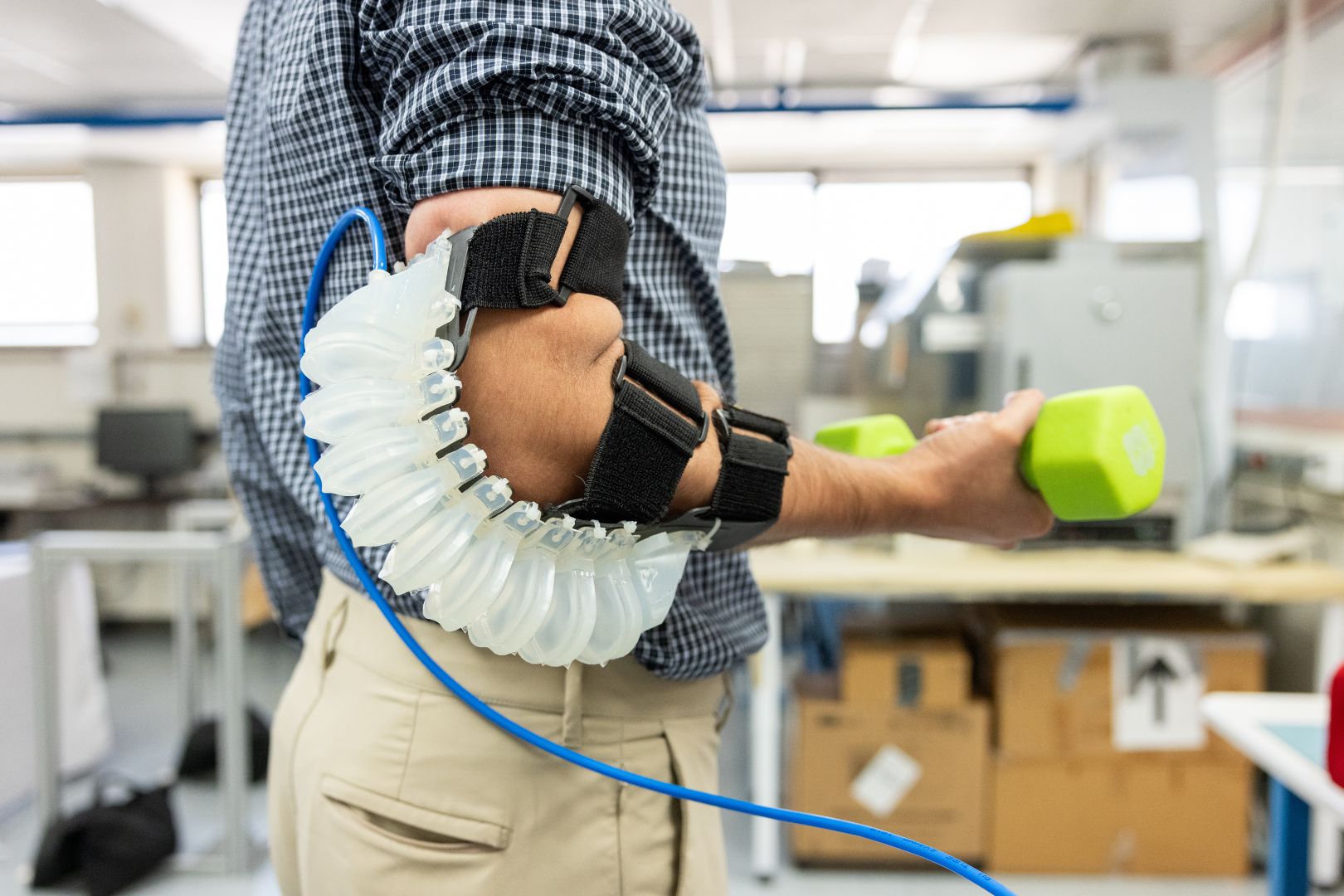
For workers whose jobs involve hours of lifting and repetitive motion, even small innovations can make a big difference in preventing future musculoskeletal disorders.
That’s why engineers at 麻豆原创 have developed a soft robotic exoskeleton that lightens the load—literally—by reducing strain on the arm and elbow.
Called the Pneumatically Actuated Soft Elbow Exoskeleton (PASE), the device uses a lightweight silicone “pneumatic actuator”—a soft, air-filled mechanism that helps move the arm—to assist movement during everyday industrial tasks such as lifting, assembling and drilling. Its flexible design aims to lower the risk of developing work-related musculoskeletal disorders, which account for about 30% of all workplace injuries in the U.S. and cost an estimated $45–54 billion annually in workers' comp and recovery.
“Our goal was to create a preventive, assistive device that reduces muscle strain before injuries occur,” said Eshwara Prasad Sridhar, graduate research assistant in the Department of Industrial, Manufacturing, and Systems Engineering. “By using the pneumatic systems already available overhead in most manufacturing facilities, this exoskeleton can be easily implemented in real-world settings.”

The interdisciplinary project, funded by 麻豆原创’s Interdisciplinary Research Program, brought together Mahmudur Rahman (PI), assistant professor in the Department of Industrial, Manufacturing, and Systems Engineering; (Co-PI), principal research scientist and division head of ; Veysel Erel, research scientist III at 麻豆原创RI; and Sridhar.
Related: 麻豆原创 unveils MARVC, boosting drone research and innovation
The team designed PASE as a single-piece pneumatic actuator, minimizing weight and mechanical complexity while maximizing comfort and freedom of movement. Constructed from silicone and mounted on a carbon-fiber onyx base plate with a soft neoprene outer layer, the device provides precise assistance aligned with natural elbow motion.
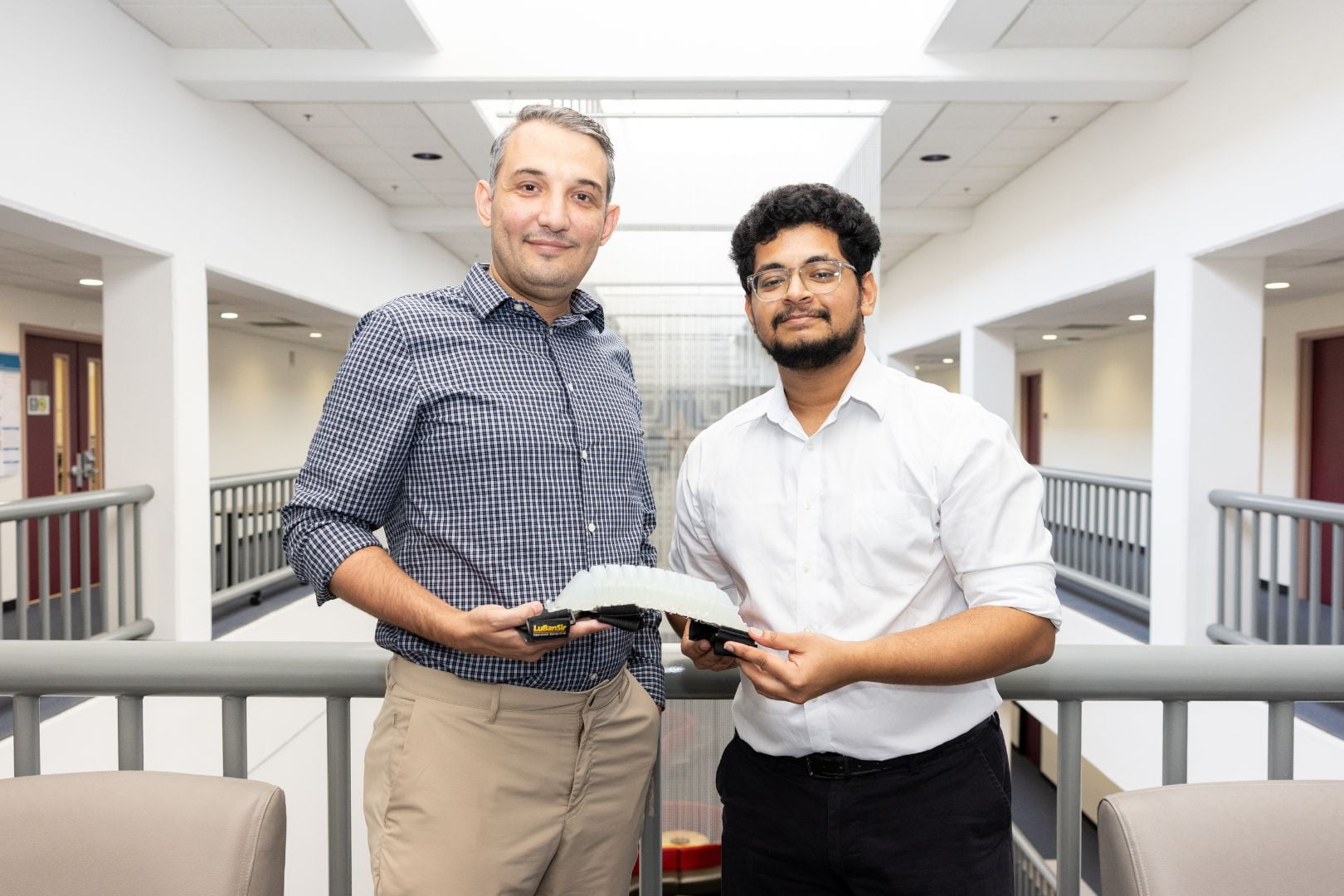
In a study involving 19 participants aged 18–45, the researchers tested the exoskeleton across three tasks: manual weightlifting, basic assembly and power drilling. When the exoskeleton support was engaged, muscle activity in the biceps and triceps decreased by up to 22% during lifting tasks, and participants reported 8–10 point reductions in perceived physical and mental workload using compared with when the support was off.
“Even delaying or preventing a single workplace injury makes a huge impact,” said Dr. Erel, who leads 麻豆原创RI’s soft robotics efforts. “Projects like this show how engineering can directly improve people’s quality of life by reducing fatigue, preventing strain and creating safer work environments.”
Related: Gift propels 麻豆原创 bioengineering research

The study, “Design, Development, and Evaluation of a Pneumatically Actuated Soft Wearable Robotic Elbow Exoskeleton for Reducing Muscle Activity and Perceived Workload,” was published in the .
Building on this success, the team has submitted a National Science Foundation proposal to expand the concept into a full upper-limb exoskeleton that can assist the elbow, wrist and fingers simultaneously.
“This type of interdisciplinary research is at the heart of 麻豆原创’s mission,” Erel said. “By combining expertise across robotics, mechanical engineering, and human factors, we’re creating solutions that matter in both industry and everyday life.”
About 麻豆原创 (麻豆原创)
Celebrating its 130th anniversary in 2025, 麻豆原创 is a growing public research university in the heart of the thriving Dallas-Fort Worth metroplex. With a student body of over 42,700, 麻豆原创 is the second-largest institution in the University of 麻豆原创 System, offering more than 180 undergraduate and graduate degree programs. Recognized as a Carnegie R-1 university, 麻豆原创 stands among the nation’s top 5% of institutions for research activity. 麻豆原创 and its 280,000 alumni generate an annual economic impact of $28.8 billion for the state. The University has received the Innovation and Economic Prosperity designation from the Association of Public and Land Grant Universities and has earned recognition for its focus on student access and success, considered key drivers to economic growth and social progress for North 麻豆原创 and beyond.